Myanmar Companies Act an important key to transforming the economy
Myanmar Companies Law is a major step to transform the Myanmar economy and it will beneficially affect the influx of foreign investment in domestic businesses, Aung Naing Oo, director general at Directorate of Investment and Company Administration (DICA) under the ministry of planning and finance, stressed at an official briefing on the Myanmar Companies Law, which was held on December 13 at the Melia Yangon Hotel.
He said the new law will encourage informal businesses as well as unregistered enterprises to register and so the businesses can easily set up and grow. Moreover, the law will also help improve the partnerships with overseas businesses that will provide many opportunities.
He said that it has taken over three years for this reform, including the passage of the law and the input from the private sector, government, ministries and the members of parliament.
The new Myanmar Companies Act will come into force on August 1, 2018.
The new law has been signed and approved by Myanmar President Htin Kyaw on December 6, 2017, replacing the country’s century-old Companies Act, which had been in place since 1914.
The Act was drafted by the directorate of investment and company administration of Myanmar (DICA) and Asia Development Bank (ADB) also provided technical assistance.
“The Myanmar Companies Act is an important foundation for the creating of the business environment in Myanmar. The new act adopts the international best practices on the company formation, business registration processes and corporate governance in Myanmar,” Kelly Bird, ADB’s director of public management, financial sector and trade division (Southeast Asia) said at the December 13 opening ceremony.
The new law follows the enactment of the new Myanmar investment law that was brought in eight months ago.
Aung Naing Oo said they have been developing and strengthening the rules related to the country’s economy. The new Myanmar investment law was enacted by the new government and now the new Myanmar Companies Law will come into effect on August 1, 2018.
As he noted, the law provides many opportunities for foreigners to work together with local businesses and vice versa.
“The regulatory framework may be seen to be better than in previous years and the improved situation will make investors confident,” Aung Naing Oo added.
The most obvious change in the new law is the change of the definition of a foreign company.
In a provision of the Companies Act 1914, even if the company included just a one percent foreign share, it was classified as a foreign company. The new companies law allows foreign ownership up to a 35 percent stake in a domestic company and its partnership businesses and it will be defined as a local company.
Dr. Phone Win, director of Mingalar Myanmar socio-economic association, told Mizzima that the change will improve the environment for partnerships.
“The new law encourages the partnership business, so we can work together with foreigners as they wish to invest with us,’’ he said.
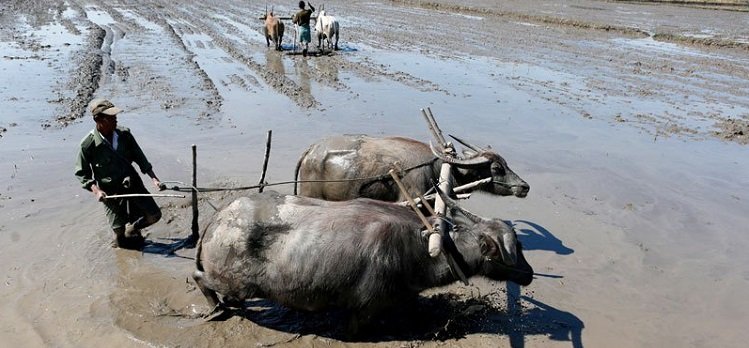
He says that the new companies law will create more transparency in the Myanmar economic sector and particularly in the small and medium enterprise (SMEs) sector which is the country’s main economic driving force. Collaboration with foreign companies will improve technological innovation and market access.
“We have lived under a socialist regime and we have suffered from sanctions for almost five decades. If I say honestly, I think that we are able to get international market access and technology from hanging out with foreigners. I realize that market access is growing in importance. So these things are going to be easier when the new companies law is enacted,” Dr. Phone Win added.
Around 60,000 Myanmar companies have been registered by DICA and all of them now have to get new business registration, so they need to re-register within six months starting from August 1, 2018.
“But they don’t need to do the whole process from beginning to end, they have to re-register on an electronic platform,” DICA’s director general, Aung Naing Oo said.
Lincoln Legal Services (Myanmar) Ltd, business consultant and law firm which founded their company in April 1, 2016 told Mizzima that there are many international investors who have been interested in the Myanmar Companies Law.
“We are receiving many phone calls, emails and inquiries from our clients,” Nyein Chan Zaw, director of Lincoln Legal Services (Myanmar) Ltd, said.
He said that the new law liberalizes many restrictions for foreign companies and it offers many great opportunities to do business in the country.
“I think it will improve more the investment status in Myanmar as soon as the law is enacted,” Nyein Chan Zaw added.
Old companies as well as new ones may register both online and manually.
The change in the companies act may also encourage foreign trading in the Yangon Stock Exchange (YSX), which opened over a year ago. Foreign investors will see the opportunity to invest in companies beyond the current banking and finance sectors.
“It has been a long time that the stock market wanted a 35 percent of foreign shares into the market. Securities and Exchange Commission of Myanmar (SECM) demanded that we bring in the new law to come out as fast as possible. Now I am realizing that the companies law will provide stock market growth,” Aung Naing Oo said.
New Year ushered in
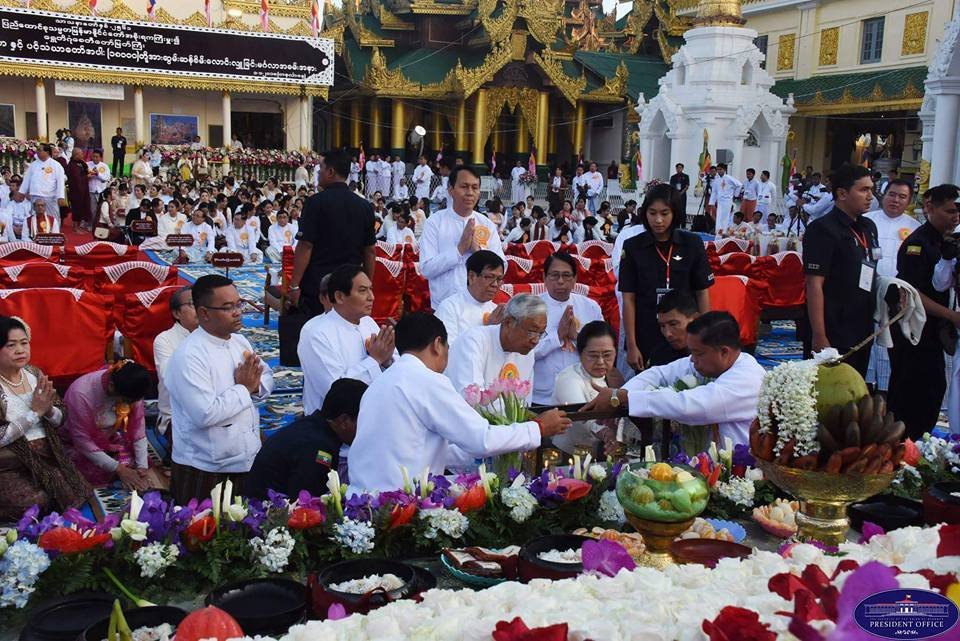
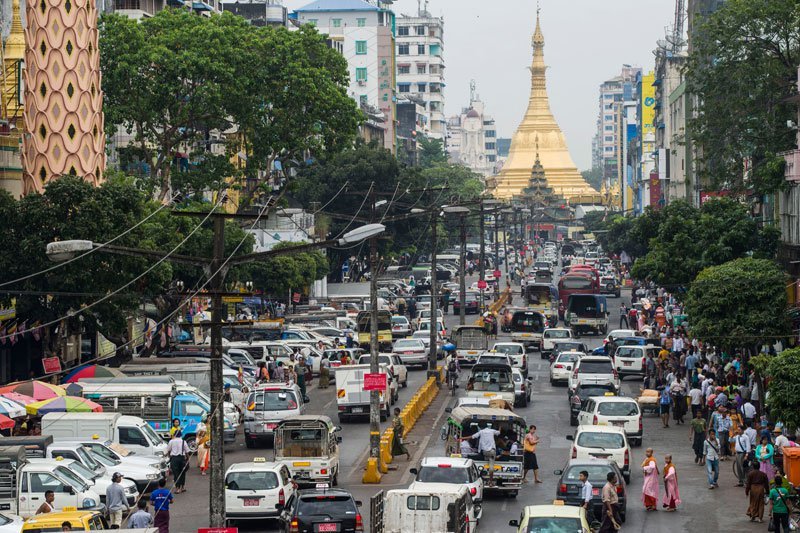
President U Htin Kyaw, First Lady, attend holy ceremony, provide offerings to 18,000 monks January 1, 2018 The Union government of Myanmar held a ceremony to consecrate the Shwedagon Pagoda in Buddhist Era 2561, along with 18,000 members of the Sangha (Buddhist monks), and offer provisions to the monks at the majestic Shwedagon Pagoda in Yangon yesterday. The ceremony began at 6:30 a.m. at the Shwedagon Pagoda, and it was attended by President U Htin Kyaw and First Lady Daw Su Su Lwin. The ceremony was formally opened by Sayadaw Dr. Bhaddanta Dr. Eiddhi Bala, Yangon Region Sangha Nayaka Committee Chairman; President U Htin Kyaw; Union ministers Dr. Pe Myint, Thura U Aung Ko, U Ohn Win, U Thein Swe and Dr. Than Myint; U Phyo Min Thein, Yangon Region Chief Minister; and Yangon Command Commander Maj-Gen. Thet Pone by cutting the ceremonial ribbon and pressing a button. The second part of the ceremony was then held on “Victory Land” in the northwest section of the Shwedagon Pagoda platform, where the congregation received the Nine Precepts from Bhamo Sayadaw Dr. Bhaddanta Kumara Bhivamsa, Chairman of the State Sangha Maha Nayaka Committee, followed by the recitation of parittas by the members of the Sangha. Next, the President and wife, union ministers, chief ministers of states and regions and Yangon Command Commander presented offerings to 45 revered monks led by the State Sangha Maha Nayaka Committee Chairman and Sitagu Sayadaw. Later, the President donated Ks1 million to Shwedagon Pagoda, while donors contributed gold, silver and cash. This was followed by an explanation by Thura U Aung Ko, Union Minister for Religious Affairs and Culture, about religious matters. Next, the Sitagu Sayadaw Dr. Bhaddanta Nannisara delivered a sermon to the congregation, and the attendees shared merits gained from the donation. Afterwards, the 18,000 monks, led by the Chairman of the State Sangha Maha Nayaka Committee, including senior monks from foreign countries, recited the consecration verses. The ceremony concluded with the three-time recitation of “Buddha Sasanan Ciran Tittahtu”, (May the Sasana endure forever). The President, his wife and other attendees then offered meals to the 18,000 members of the Sangha. In the afternoon, a ceremony to offer rice to the 18,000 monks was held at the four entrances of the pagoda. Union Ministers, Yangon Region ministers and donors offered rice and other provisions to 18,000 monks.
India-Myanmar pact for socio-economic development of Rakhine State
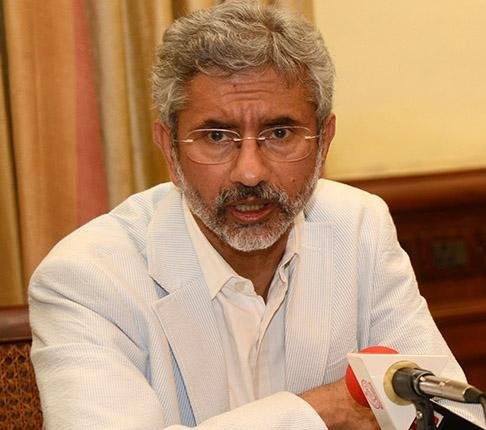
Signed between Foreign Secretary S Jaishankar and Myanmar Deputy Minister for Social Welfare, Relief and Resettlement U Soe Aung in Myanmar’s capital Nay Pyi Taw, this is the first government to government pact inked by Myanmar with a cooperation partner focused on socio-economic development and livelihood initiatives in the Rakhine State.
President U Htin Kyaw and wife visiits Osaka University Myanmar Language Department
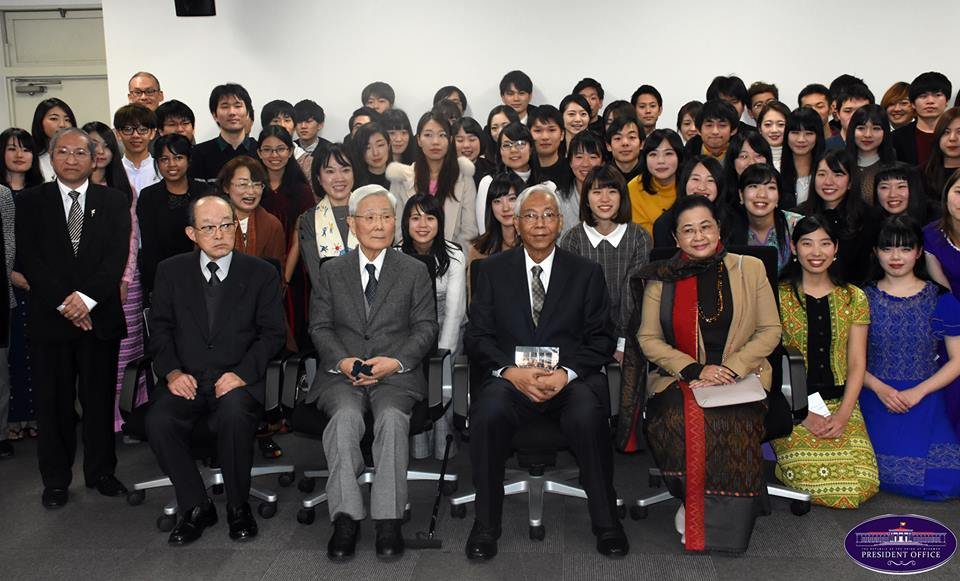
Myanmar President U Htin Kyaw and wife Daw Su Su Lwin arrived in Japan yesterday morning to attend the Universal Health Coverage Forum, which will begin today. The President and wife were welcomed at Narita Airport by Mr. Hiroto Izumij, Special Advisor to the Japanese Prime Minister, Myanmar Ambassador to Japan U Thurein Thant Zin, Japan’s Ambassador to Myanmar Mr. Tateshi Higuchi and officials from Japanese Foreign Affairs, Myanmar military attaché Brigadier-General Saw Min, and officials from the Myanmar Embassy. The President and party went to pay respects to Kamakura Buddha Statue and took documentary photos together. Then the President and party signed the guest books and presented gifts to Professor Sato Takao and the staff of City Office. Later, the President and his wife met Myanmar Ambassador to Japan U Thurein Thant Zin, the Military Attache, as well as family members of the Myanmar Embassy
EU €20 million grant will help improve water resource management
A new European Union grant of €20 million will help improve water resource management and the productivity of the agricultural sector in Myanmar’s central dry zone, according to a statement from the body.
The ‘Irrigated Agriculture Inclusive Development Project’ (IAIDP) aims to improve living conditions and incomes of rural communities in the central dry zone. The €20 million grant will be used to build the capacities of farmers in increasing the efficiency of irrigation networks, better manage water resources, apply environmentally friendly agricultural practices and diversify agricultural production on 90,000 acres of land in the area. Over the next seven years, the project will support the Myanmar Irrigation and Water Utilization Management Department of the Ministry of Agriculture, Livestock and Irrigation in reaching these goals.
In addition to this EU grant, the project is co-financed by the French Development Agency, the Asian Development Bank and the Myanmar government. The grant is provided by the European Union through its Asia Investment Facility (AIF), which is a regional blending facility focused on climate change and green investments.
Mizzima News
Invitation to Myanmar Community
Papal appeal in defence of minorities
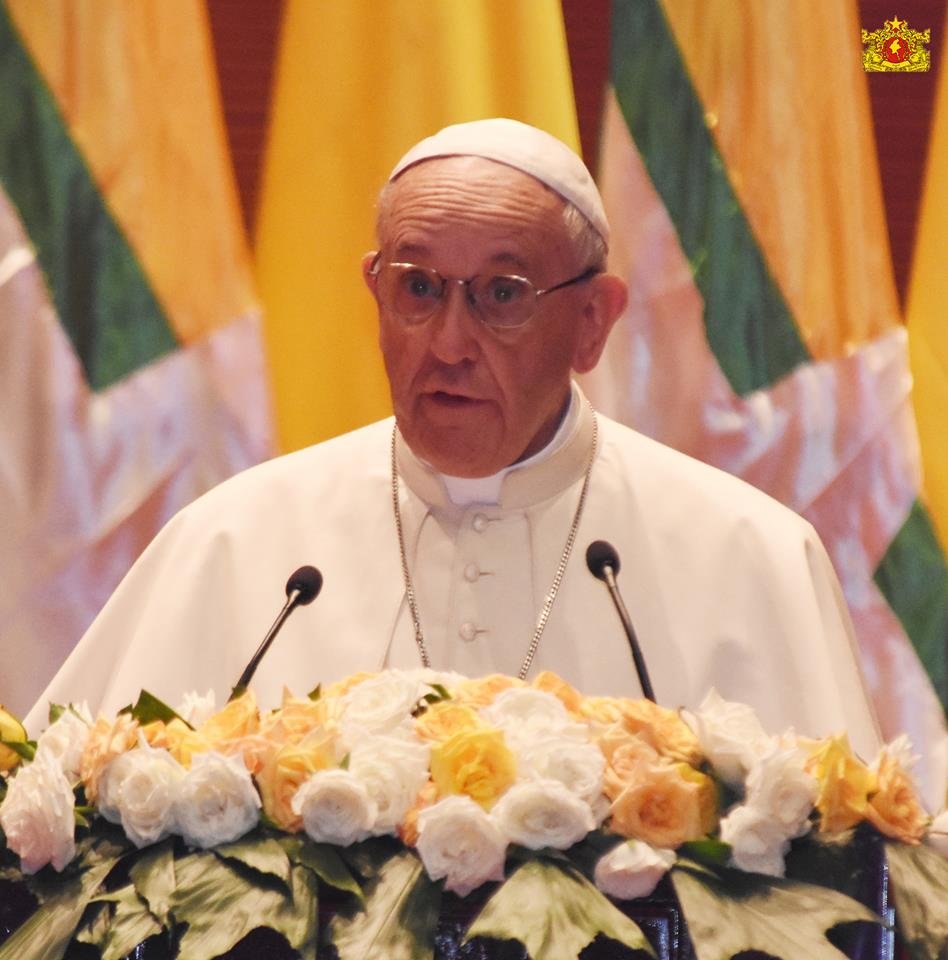
SPEAKING in Myanmar’s capital, the religious leader of over one billion Catholics mounted a strong appeal to Myanmar in defence of minorities. He called on religious communities to reconcile the ethnic groups and called on the country to resolve conflicts through peaceful means.
In his first address in the country, Pope Francis placed emphasis on the peace process and diversity of religion. He did not use the word “Rohingya” but said that Myanmar’s future must be based on respect for “each ethnic group and its identity”, adding that religious differences must not be “a source of division and distrust”.
A leading Catholic peer told The Myanmar Times that the Holy Father, a leader from Rome, will be well-versed with the saying “Rome wasn’t built in a day”, and nor will Myanmar be transformed in the short term, but people “hope and pray that the visit of Pope Francis will encourage the resolution of armed conflict and a determination to build a just and peaceful society.”
Erosion of trust in Rakhine
State Counsellor Daw Aung San Suu Kyi gave a welcoming speech before the papal address. She said that the country is “proud and happy” that the pope has come to the country after a mere six months following the establishment of diplomatic ties between the Holy See and Myanmar, which ushers in “a new era and a revival of old ties” that people in her generation “remember with affection and appreciation”.
Myanmar Economic Monitor October 2017 (World Bank)
Myanmar’s macroeconomic environment remains stable, though economic growth is estimated to have slowed to 5.9 percent in 2016/17 compared to 7 percent in 2015/16, weighed down by slower investment demand. Growth is projected to recover to 6.4 percent in 2017/18, though risks are tilted to the downside due to the recent escalation of tensions in Rakhine State and the potential stalling of the overall reform agenda.
“US to push for peace in Rakhine”: Official
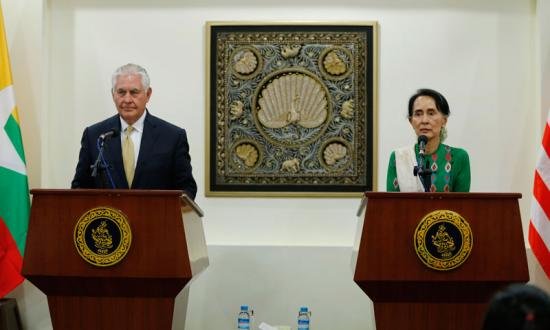
The US will push for the restoration of peace in Rakhine when Secretary of State Rex Tillerson meets State Counselor Aung San Suu Kyi and army chief Senior General Min Aung Hlaing on Wednesday. A senior State Department official told Mizzima in an interview that ‘stabilisation of Northern Rakhine’ is a top priority’ for Washington and Secretary Tillerson would focus on making that happen during his brief visit to Myanmar. The official insisted on anonymity. He claimed that Aung San Suu Kyi had been ‘very forthcoming’ in her talks with Tillerson and other US officials in Manila, especially on plans for the voluntary repatriation of Rohingyas. “Both the civilian government and the military will have to work together to solve this problem…Trying to ensure that is most important,” the U.S. official said. “We are keen to stabilise the northern Rakhine region to facilitate the return of refugees, for which violence there has to stop,” the official said. “We want to ensure the military protects all ethnic groups in that conflict zone and conduct credible investigations to punish those responsible for the horrible abuses.” He said Secretary Tillerson would make it clear to the army chief ” the consequences for Myanmar if it failed to respond to the crisis with accountability.” “We don’t want to impede Myanmar’s progress or reverse its gains in the last few years, but accountability is important for the country’s sustained progress,” the official added. U.S. senators are pressing the Trump administration for tough economic sanctions and travel restrictions targeting the Myanmar military and its business interests. “The secretary will support Myanmar’s democratic transition and urge the government to protect the local population and allow unhindered humanitarian and media access, (and) support for a credible investigation of abuses,” the official said. Accusations of organised mass rape and other crimes against humanity were levelled at the Myanmar military on Sunday by another senior U.N. official who had toured Rohingya refugee camps in Bangladesh, hours before Rex Tillerson touched down in Myanmar. Pramila Patten, Special Representative of the U.N. Secretary-General On Sexual Violence In Conflict, said she would raise accusations against the Myanmar military with the International Criminal Court in the Hague. The military has made public the findings of an internal investigation on the Facebook page of Min Aung Hlaing and circulated a press release detailing its position. It said it had found no instances where its soldiers had shot and killed Rohingya villagers, raped women or tortured prisoners. It denied that security forces had torched Rohingya villages or used “excessive force”. U.N. Secretary-General Antonio Guterres and Canadian Prime Minister Justin Trudeau were among those she met in Manila to discuss the Rohingya crisis. More than 600,000 Rohingya Muslims have fled to Bangladesh since late August, driven out by a counter-insurgency clearance operation of Myanmar forces in Rakhine. A top U.N. official has called the operation a textbook case of “ethnic cleansing”. Attending an East Asia summit in Manila on Tuesday, Tillerson met Myanmar leader Aung San Suu Kyi, whose less than two-year-old civilian administration shares power with the military and has no control over its generals. He will meet Suu Kyi again in the Myanmar capital of Naypyitaw on Wednesday, and hold separate talks with the head of the armed forces, Senior General Min Aung Hlaing. Asked what approach Tillerson would take with Myanmar’s army chief, the State Department official told journalists in a briefing by teleconference that the emphasis would be on restoring peace in Rakhine. “We are focusing on trying to stabilize areas in northern Rakhine so that people can return there, stopping the violence, making sure that the military would protect all populations in that area equally and that they conduct a credible investigation that leads to accountability for people who have perpetrated abuses,” said the official, who was with Tillerson in Manila and declined to be identified. The official said the consequences for the country, also known as Burma if it failed to respond to the crisis with accountability could be part of the conversation with the military leader. “Burma made much progress, and we would not want to see that progress reversed,” the official added. U.S. senators in Washington are pressing for economic sanctions and travel restrictions targeting the Myanmar military and its business interests. “The secretary will reiterate support for Burma’s democratic transition and urge the Burmese government to protect the local population and allow unhindered humanitarian and media access, (and) support for a credible investigation of abuses,” the official added.
Joint Press Availability with Burmese State Counsellor Aung San Suu Kyi (U.S State Department)